Long before Almuruna existed, there was already a conviction that still shapes how we work today: people do not become stronger when we mainly look at what is missing.
They grow stronger when we also see what is already there and help them build renewed direction, confidence and possibilities from that starting point.
That conviction grew out of working with people. Today we also apply it within teams and organisations.
Our name
Almuruna means resilience and flexibility
Almuruna is an Arabic word meaning flexibility, adaptability and resilience. These ideas are closely connected. Resilience does not mean that people or organisations must be able to endure everything. Nor does flexibility mean that they must constantly adapt to whatever their surroundings demand.
It is about the ability to deal with changing circumstances without losing sight of what matters. That takes perseverance, a willingness to adjust course and the courage to let go of familiar ways of working when needed.
“Steady enough to hold direction, flexible enough to move forward”
Where it began
Looking at what is already there
Almuruna has its origins in the work of Najima El Kasmi. She spent many years working with people in socially vulnerable circumstances.
During those years, she saw how quickly people can be reduced to their problems. To what they lack: education, financial resources, a network, stability or opportunities.
Drawing on her experience, Najima developed an approach that starts from what people already have within them. From the strength they previously needed to keep going, the experiences they have gained along the way and the possibilities to make their own choices again.
That did not mean ignoring or underestimating difficulties. By also paying attention to what people did have to draw on, there was room to strengthen their confidence, agency and possibilities.
From those years of practice, her expertise grew and she developed methods around resilience, human dynamics, leadership, communication and change.
From people to organisations
When Najima and Björn Slegers began bringing their experience together, two different professional worlds met.
Björn brings many years of experience in management, strategic HR and organisational development. He understands the challenges facing organisations and their leaders, from strategic choices and complex change processes to the everyday reality of employees and teams.
Despite their different backgrounds, they recognised many of the same patterns.
When faced with change, organisations often look quickly for a solution. A new model, a different structure, additional technology or an external programme may well be needed. But that does not yet mean the organisation will be better prepared for the next challenge.
Their combined experience gave rise to a question that still guides Almuruna today: how can we address a concrete issue while strengthening an organisation’s ability to handle future challenges better itself?
That combination of human dynamics, strategic insight and organisational development forms the basis of our approach today.
We grow organisations
Resilience is the foundation, growth the result
When we talk about growth at Almuruna, we mean more than scale, turnover or a larger workforce.
We also see growth in a leader who becomes more confident in taking difficult decisions. In a team that takes responsibility without needing approval for every step. Or in an organisation that dares to adapt its structure when it no longer matches its ambitions.
Growth also lies in the ability to learn from what happens, recognise new possibilities and actually turn choices into action.
We grow organisations.
“Everything, the whole experience, comes together and helps you reflect differently, look for solutions and see that every problem has a solution tailored to it.”
FOD IBZ
Why we look at the whole
When something gets stuck, what becomes visible is not always the same as what causes the problem.
A team may struggle to work together because something is going on between its members, but just as well because responsibilities are unclear or different managers expect different things.
A leader may need support in their role, but sometimes the real question lies in a strategy that is not sharp enough, a mandate that is missing or a structure that makes good leadership unnecessarily difficult.
That is why we look beyond the first symptom: at people and leadership, and also at structure, decision-making, learning, data and technology. That need not make a question more complicated. It helps to understand what is going on first, before we decide what is needed.
Resilience
When the organisation itself needs to change
Resilience is not the same as learning to put up with what does not work.
In organisations, resilience sometimes becomes almost synonymous with teaching people to cope with ever more pressure. But when employees structurally have to go beyond their limits, the question cannot only be how we make them more resilient.
The same applies to teams that constantly clash or leaders who keep getting stuck. People can develop, but we must also dare to examine whether the environment in which they are trying to function is clear, healthy and workable enough.
Organisational resilience therefore does not lie only in people. It also lies in the way an organisation listens, decides, organises and changes when something no longer works.
Founders
Who founded Almuruna
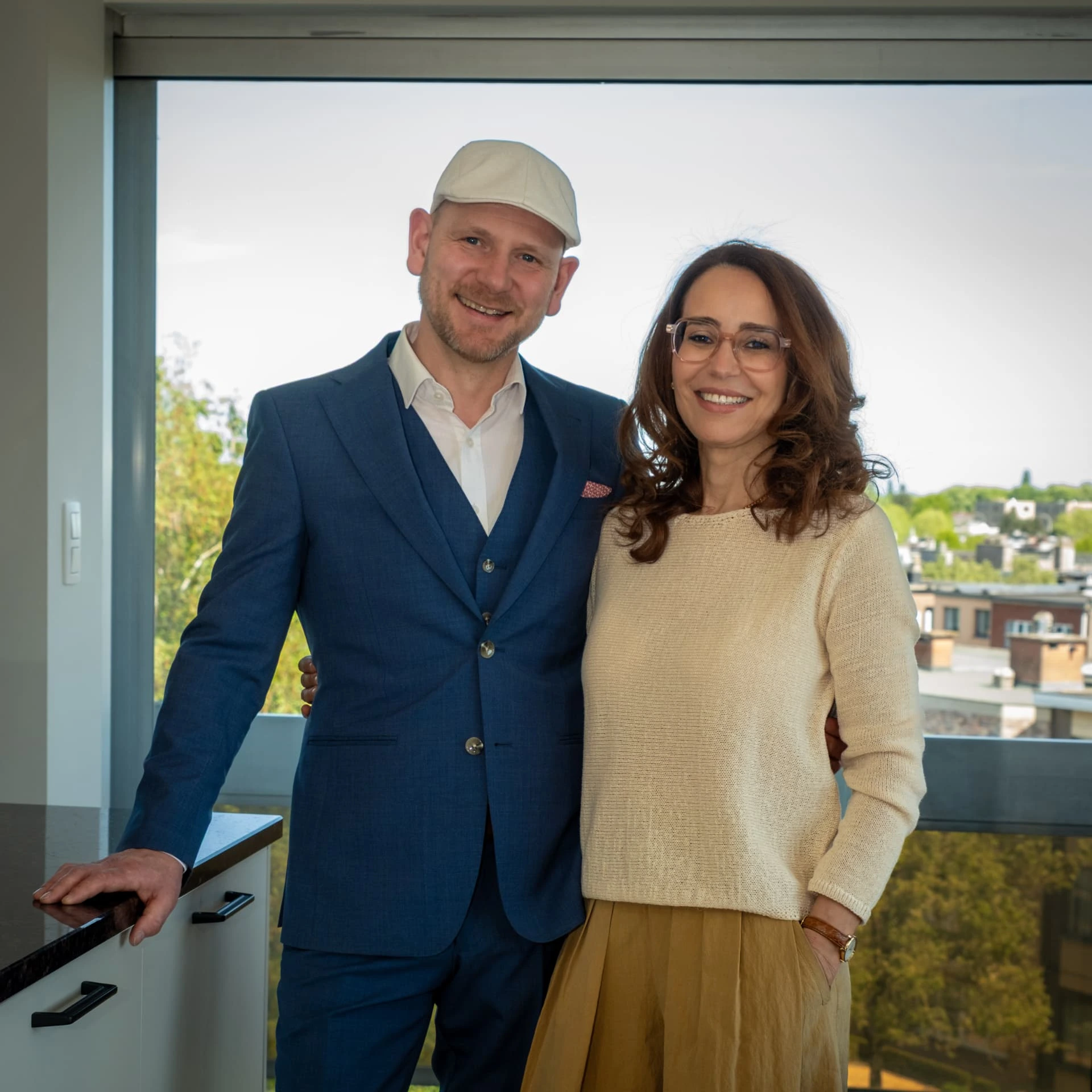
Najima El Kasmi and Björn Slegers each brought a different professional history to Almuruna.
Najima developed her expertise through many years of practice in resilience, leadership, communication, group dynamics, coaching, mediation, negotiation, inclusion and organisational development.
Björn built his experience in management and executive HR, with a strong focus on organisation design, governance, transformation, industrial relations, people analytics, technology and strategic decision-making.
Within Almuruna these backgrounds deliberately intertwine. Najima does not only work with people, and Björn not only with structure or technology. For programmes we also work with a network of trainers, facilitators and experts, and with professional actors where practice is central.
Almuruna today
Four domains, the same organisation
Leadership & People focuses on the human dynamics within organisations and on leadership, collaboration, communication and culture.
Strategy & Organisation looks at the choices, structures and conditions that determine how an organisation can function and grow.
Through the Academy we build knowledge and skills that can live on within the organisation itself.
With Almuruna One we bring technology, data and context together to help people see more quickly what is going on and to underpin decisions better.
The starting points differ, but the four domains look at the same organisation. A question often touches more than one.
The role of technology
Data and AI can make a lot of work faster and more consistent. They can connect information, help recognise patterns and make context more accessible.
Not everything that matters in an organisation can be captured in data. People know their environment, hold conversations, understand nuances and carry responsibility for the choices that are ultimately made.
So we do not use technology to automate human decision-making away, but to give time back and make better information available to those who have to decide.
“Data and AI signal, people decide”
Where we want to go
What remains after a programme
When we guide leaders, we want them to be able to carry more themselves over time. When a team works with us, something should remain that goes beyond a good conversation. When we work on strategy or structure, we do not just want to deliver a design, but to help build an organisation that can actually work with it.
The same applies to learning and technology. A training has little value if the knowledge does not find its way into practice. And a system solves little when it mainly creates a new dependency or additional complexity.
Getting to know Almuruna
What began years ago with a different way of looking at people has today grown into a way of looking at entire organisations.
Leadership, human dynamics, strategy, learning, data and technology are not separate disciplines here. They help an organisation make choices and build further on what it already has in-house.
We grow organisations.